Pirin Pee (its means sings, its pronounced "pae") | Пирин Пее
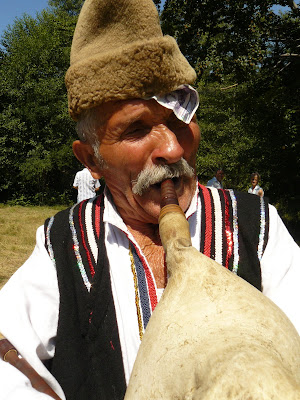
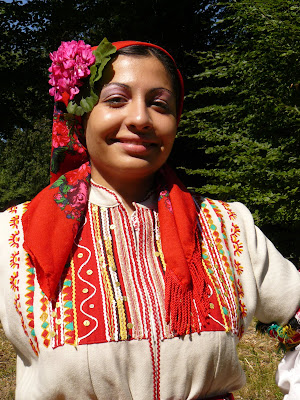
The Bulgarian folklore festival in Predel just ended today, I thought I would post some of the photos. The location is absolutely beautiful and the name of the festival is fitting because the mountains really do sing with folk music.
It was a great experience and I'll posts about the weekend following this week.
Before living abroad, I always found "world music" or "international music" or "ethnic" music" interesting and strange; meriting a once-through so I could feel like the proper cultured American. However, I feel that I am coming to a better understanding of, not necessarily music from different cultures, but how our American culture processes music from other cultures by bastardizing it and commercializing it. Granted, these aren't necessarily bad things but I think its important for it to be raised in the discussion.
Some Observations without Accusations:
==>Insert White Man Here<== International Music cool and all, and we like listening to it. But, honestly, we need a somebody from "our" side playing it. It makes us comfortable and we are more likely to (most importantly) buy it.
If ain't in the NY Times . . . it might as well not exist within the culture framework of America. It's not because the NY Times is pretentious (it is) or that the NY Times has better access to good music; its just that we want someone or something with some sort of culture authority telling us what to think. That's like a whole dissertation right there and I don't really want to write too much about it. So, just think about it. It ain't bad, just consider your sources before you go all I'm-in-the-know and whatnot.
Yeah, but could you rap over it? Jay-z anyone? Some call it sharing cultures with music but its just seems rather authoritative and heavy handed to throw down a guitar and drums or cool rhyme on everything that comes through our proverbial Ellis Island of international music. It just shows again that we need to be linked to the music somehow to be able to create a common interest. Without a white man, authoritative cultural figure or Americanizing it, it hard for Americans to absorb the music. We need that link.
The Ipod Movement You have your playlist of perfectly optimized songs and I have mine. And, sure, we like sharing our Ipod with our friends (a sort of whose belt is longer contest: "Oh you've got Mates of State? Yeah, but did you see Peaches on there? I just like their first album . . "). With the Ipod movement, we run the risk of creating our own worlds impervious to outside influences. Sure "our worlds" are rather cultured and broad but it takes a lot of work to find new music 1) Go to a Computer 2) Find new music through website/friends/Last.fm 3) Illegally download 4) Hack Itunes to be flexible. That makes us willing to try "new Music" or world music but we limit ourselves because each song takes work. We just want the best ones whereas with the radio, it is meant as a background to your day. Not the focus. This means that most people have selections of Balkan music and its is more difficult to have a broader spectrum.
Yeah, but is it REALLY Roma/Balkan/Folk? I don't know the answer to that one. But think about it: LE MYSTERE DES VOIX BULGARES are the uncontested symbol of Bulgarian Folklore music but the name of the group is in . . . French. I just don't know.
The Kiss and Makeup with America:
So does this mean that western style artists are exploiting the Balkans and aren't playing "real" Balkan music? My answer would have to be a resounding, Does it matter? Is it good music? Do you enjoy it? Well, then its real enough for me. Now, whether or not it can be stamped with a packaged, sealed and marketed brand saying "The Real Balkan Sound" is a different question. I can say with almost certainty that most people from the Balkans have never heard of these new and up and upcoming bands in America (I'll be posting about them later).
So, lets just say that its got a "Balkan sound" or its influenced by the "Balkan Music". And that's cool.
So, whenever I introduce a band or artist with bastardized or westernized Balkan Music, I'm going to list it as: Balkan Influences . This allows the people to become aware of really cool Balkan Influenced bands but not misunderstand them for music from the Balkans.
The Balkan Hour | Balkan Influences
Do Balkan Influences need to be discussed within the same discussion of Balkan Music? Of course! What better gauge do you have of what outsiders perceive as interesting and captivating? It allows one to observe what it says about the outsider's culture as well. (Such as Bulgarians affinity to western hip-hop and pop that's solely danceable).
Gypsy TV is an new commercial media venture to raise awareness about Roma culture and identity. Located in Bulgaria, it focuses mostly on Roma living in Bulgaria. Often the Roma culture and traditions in Bulgaria are overlooked internationally and also nationally. This station is an excellent viewing glass for Romani culture and traditions in Bulgaria. Its a bare bones production that will seem to most Americans somewhat amatuerish. But its worth tuning into every once a while to listen to the music programs. Most of the programing isn't in English, so if you hit it at the wrong time its not really going to be that captivating.
Historically the homeland of Alexander the Great, Macedon was a ancient kingdom that became a geographic region over time. When the Ottoman Empire fell, the the preceding power vacuum caused the political national groups of Serbia, Bulgaria and Greece to fight over the spoils. The Balkan Wars thus ensued and everyone ended up hating each other.
Macedonia, the word, is a time bomb waiting to happen. And that has happened, more than once. Over the past 100 years, four countries have been simultanenously claiming their Macedonian heritage and the Macedonian name much in the the way that Italians would claim their Roman heritage. The heritage is there . . . but there isn't exactly a clear definition of who is from the ancient Macedonian kingdom. Like most things in the Balkans, you get many nation states claiming a common heritage and making it an issue of national pride who is really (for instance) "Macedonian".
When the dust settled, Serbia had gained the lion's share of the region by making it a republic in its ill-conceived federation of states. Bulgaria lost a large portion of the ethnically Bulgarian regions and was left with the Pirin Mountains. Greece claimed the large southern part with the largest city Thessaloníki--the very same city that birthed the founder of the modern Turkish state-Mustafa Kemal Atatürk. Again we have the wonderful soft contradictions permeating the Balkan culture.
What the heck does FYROM Mean?
About 15 years ago, some of you might have noticed that a new country popped up in the Balkans called FYROM and you probably paused for a second to remark on its awkwardness. I bet even some of you tried to pronounce it (hand raised) -- f i r o m ? It actually stands for Former Yugoslavia Republic of Macedonian, which was the official name of the country when it was recognized in 1993 by the United Nations. Why would any budding nation choose to A) Pick an incredibly awkward acronym that stupid Americans would think is the actual name of the country, B) mention the country the declared independence from in their nation's name (Former English Colony United States of America, FECUSOA)? Answer: Well, someone had already taken that name . . . actually two countries, both Bulgaria and Greece.
The largest geographical region in Greece is called Macedonia and I'm sure you could imagine the confusion and outrage of the Greeks that their newly formed neighbor to the north was called the same name as their own territorial claim to Macedonian linage. This outrage caused Macedonia (now we are talking about the political state) to be initially called FYROM within the international community.
Greek Macedonia
Bulgaria also lays claim to name Macedonia to describe its southwest region encompassing the Pirin Mountains. This is seen more as a description of a cultural and territorial region than as a politically recognized region.
Pirin Macedonia
So, one has to create a fine but important line between the political Macedonia and the cultural Macedonia. There are parts of traditional Macedonian culture sprinkled throughout the northern part of Greece, southwest Bulgaria, Serbia, Kosovo and Macedonia.
Bulgarian or Macedonian Folk Songs?
When a Bulgarian from the southwestern Bulgaria (Macedonian region) celebrates a national holiday, birthday or festival, he (usually not she . . .) starts drinking rakia--grape brandy that is akin to moonshine--and sings the traditional folk songs that were taught to him as young child. But in this region of Bulgaria, what are those folk songs . . . ? They're old Macedonian songs from before Macedonia and Bulgaria where divided from the Balkan Wars.
When browsing the online chatter, Macedonians are indignant that Bulgarians sing Macedonian folk songs. Those songs represent a nationalism that is being attacked by other countries claiming those songs as part of their cultural ethos. Bulgarians are, for the most part, dismissive of Macedonia and its claims of difference--almost as if they were a the prodigal son that joined Serbia and will one day return. The conversation almost always ends with "Oh, they are Bulgarians; they speak Bulgarian with an accent".
So which are they, Bulgarian folks songs or Macedonian folk songs? Neither. They are folk songs sung from the geographic region of Macedonia in both Macedonia and Bulgaria. (How about that for running a fine line . . . )
This weekend, I will be attending the Pirin Sings (Пирин Пее) in the Pirin Mountains and I hope to gather a better picture of the traditional folk music played there. Pirin Sings (Pirin Pee or Пирин Пее) is a folklore festival held every two years on the first weekend of August where thousands gather in the mountain meadows for singing, dancing, drinking and eating. What's not like? Its a recommended hidden jewel of Bulgaria for intentional tourists.
I'll post examples of Macedonian music after the weekend, but for now, here's a famous Bulgarian Macedonian Folk Song that is sung in both Macedonia and Bulgaria.
Tangentially Referenced:
For anyone that has access to JSTOR, this is a great article about the Politics of Folk Music in the Balkans: The Politics of Folklore in Bulgaria, Carol Silverman


 Posts
Posts

