Good Example of Up Tempo Roma Music (Macedonian/Bulgarian Wedding Music)
More Commercialized (General Appeal) Style:
Amza Tairov is one of the most famous Tallava / Roma Music Musicians. Popular throughout most of the Balkan Roma Communities, Amza is known for revitalizing the synthesizer from a cheaper substitute for a original instrument into something regarded with respect in its own right in the Roma Community. With lightning fast finger work combined with lavish embellishments, the music has a ranges from fast paced dancing music to sorrowful notes lingering in the night.
In this particular collection, Amza is paired with a child singer (Dejo). The music is slower and the vocals seem to dominate unlike the Roma Music (Macedonian/Bulgarian Wedding music) that Amza has done as well.
If you know the owners of this content, please contact The Balkan Hour. We are more than happy to remove links upon request. We also would happily post links for CD sales, future concerts or general information. The music here is meant to inform and to altruistically create a larger market for the music. Anyone can stop this link from Rapidshare by clicking this link:
KILL CODE FROM RAPIDSHARE (Removes Music, Don't Click Unless You Want to Remove the Link!!!!)
Внимание:
Ако знаете, собствениците на тази музика, моля свържете се с Балкан час. Ние също така ще бъде щастливо да публикувате връзки за CD продажби, бъдещи концерти или обща информация. Музиката тук има цел да информира и да създаде по-голям пазар за музика.
This is a more well known CD by Sevchet with many Chalga hits on it such as Chokolada, Pare Pare and others. Cita is also featured on this CD but I can't identify the tracks on youtube for preview. I've attached a live recording of Cita instead. Definitely Check out this CD
If you know the owners of this content, please contact The Balkan Hour. We are more than happy to remove links upon request. We also would happily post links for CD sales, future concerts or general information. The music here is meant to inform and to altruistically create a larger market for the music.
Внимание:
Ако знаете, собствениците на тази музика, моля свържете се с Балкан час. Ние също така ще бъде щастливо да публикувате връзки за CD продажби, бъдещи концерти или обща информация. Музиката тук има цел да информира и да създаде по-голям пазар за музика.
Sevchet is one of more popular figures of Macedonian Tallava. He straddles many different styles of music ranging from Chalga/Pop-Folk to Rap to Wedding Music. He's definitely a figure to watch. I'll be posting one of his more famous CDs a littler later so be sure to check in again for more Sevchet
If you know the owners of this content, please contact The Balkan Hour. We are more than happy to remove links upon request. We also would happily post links for CD sales, future concerts or general information. The music here is meant to inform and to altruistically create a larger market for the music.
Внимание:
Ако знаете, собствениците на тази музика, моля свържете се с Балкан час. Ние също така ще бъде щастливо да публикувате връзки за CD продажби, бъдещи концерти или обща информация. Музиката тук има цел да информира и да създаде по-голям пазар за музика.
The name may not be the clearest and the Russian may be a little daunting to non-cyrillic speakers, but NoNaMe and its world music website has some of the most eclectic world music I've seen on the Internet. The site seems to have a special love for Balkan music while still having selections from around the world.
You have to register which is just a simple login, email, password and password confirmation. To non-cyrillic speakers, you have to click the " регистрация" in order to get the registration page. Or you can just click here to register.I know, its daunting at first but all the posts are in english and its pretty easy to navigate
Here is just a quick list of the quality Balkan Music I've found on the website:
There are 92 pages of music, at roughly 15 posts each. . . makes almost 1400 entries of fully downloadable music with reviews, commentary and history of each artist. This is definitely a great resource for those wanting to learn more about Balkan Music and World Music in general.
Last Monday, I finished my training with WRFL 88.1 Lexington to be a Radio DJ. WRFL is the local student radio of University of Kentucky and has a strong history of supporting alternative programming for central Kentucky. Hopefully, I'll be able to play music from the Balkans with WRFL to create a better awareness for the region and to promote artists from the Balkans. This is me on the WRFL website: The Balkan Hour DJ
Anyway, the trial run was great fun and full of freshman mistakes. I'll get the hang of the sound board and other techical details as I practice. Generally, I'm content with the trial run. I would like to have more historical context with better descriptions of each artist or style, some that the Oberlin podcast/radio show is a great example. But I suppose that will come with time.
Please be aware that the beginning and end of the audio are of other radio shows because the .mp3 is archived per hour and not by user. I'll look into sound editing to clean it up. So, keep listening past the first couple of seconds!
I just happened upon a gold mine of information about Balkan Music online in the form of series of blogs required by an Oberlin College music class. The class is being taught by Jennifer Fraser, an Assistant Professor of Ethnomusicology at the Conservatory of Music at Oberlin College. The course covers a broad array of musical styles and regional genres ranging from Turkish Folk to Roma Music to Bulgarian Folk music (among others).
Here is what Jennifer Fraser has to say about the course and its blog initiative in her first blog post:
This site is dedicated to writing about and sharing our experiences interacting with these musics, along with articulating the connections between musical style and socio-cultural meanings; for example, how was music used to express sides during various Balkan wars in the 90s? How can you trace the history of socialism and roads to democratization and economic independence through musical practices in the Balkans? How do the cultural legacies of the Ottoman and Austro-Hungarian empires play out in the musical practices of today?
From my cursory browsing through the subject matter, it looks like a fascinating course that approaches Balkan music the way it should (in my opinion) be approached; through a historical, socio-cultural lens. Apparently, it just isn't me that is fascinated by the symbolic nature of Balkan music and its mixing of cultures. Regardless, I encourage those interested in Balkan music to browse through ETHN 209 and its blog posts. They the blogs are written by university students so the quality ranges between insightful to bland but it continues the conversation. These students study at the Oberlin Conservatory of Music so they are often have a much different approach to music compared to myself because they have a better understanding of the musical structure and also the historical background from other genres and styles. So, without further ado, here is the Ethnomusicology209 course for Oberlin College:
While the entries are great, I and many other international readers probably won't want to wade through all of the individual websites to browse the collection of opinions about Balkan Music. To counter that, I have created a Google Reader of the entire class which compiles all the submissions of every student in a central place. It should update automatically whenever a student has a new post. But readers can also click the title of the post to go to the individual blog as well. Here is a public RSS Feed page that you can click to view all of the post in a centralized blog format:
Sevchet is a Romani musician from Macedonian who straddles Tallava / Traditional Romani music and hip-hop / Rap. Here is a live recording of Sevchet (sometimes written Sevcet or Sev4et; 4=c=ch in Slavic languages sometimes online). This would probably be classified as Tallava but it would be also called just Roma music in Bulgaria.
Here is a solo performance of Amza Tiroif. Some things of note about Amza:
He's a one man band that compliments other musicians or can go alone
He plays a variety of music and there is a influence of Balkan Folk music (at least Bulgarian) but he improvises live and embellishes heavily.
He's from Macedonia, but plays all over the Balkans for Roma concerts/parties.
It also says something of the staying power of the Synthesizer in Roma Music (Mentioned Previously). Obviously, the instrument has been legitimized within the region just by virtue of the demand of musicians that play it.
And other names in other countries but I don't want to spread my definition too thin.
Generally, the genres are very similar: Women in minimal amounts of clothes, simple lyrics at appeal to a large mass and music influences all over the world. So when referring to Chalga one must make a distinction between popular "Chalga" or Pop Folk and more traditional Chalga music from the past (wedding music, roma music).
I hope to give some more examples of Chalga or Pop Folk later on this month in the Daily Dose . I just don't want to confuse the music too much.
One of the most well known Balkan Romani singers is Esma Redžepova. She started her career at age fourteen when she competed and won a Macedonian singing contest in Skopje. She then joined the Stevo Teodosievski Ensemble where the Ensemble leader later became her husband. After much success in the Balkans, she now tours internationally. She also, similar to Oprah in some ways, started her own music school for unfortunate Romani children. Esma Redžepova has also adopted over 50 children from Macedonia and has her own foundation to help her fellow Roma who are less fortunate
Please read more about her at her official website or the wikipedia page (it isn't the best, but its great for quick info)
So, basically, Esma Redžepova something similar to Aretha Franklin, Madonna and Judy Garland. She started her singing career early (professionally on the road at age 14), became a symbol of Romani everywhere by raising awareness and simultaneously being a pop star.
Basically, when discussing Roma music and Balkan music a presence that needs to be mentioned, admired and acknowledged. I've assembled a playlist of some of Esma Redžepova's work over the years, starting from when she was young to her 4:oo Minutes to Save the World song to prove she's still got it.
Some of you might find it easier to navigate through the playlist from YouTube page. I'm not having much luck embedding the playlists, so I've embeded all of the videos on this page.
Esma Redzepova - Caje Sukarije By far, this is her most famous song. There are newer versions but I think this archive footage captures the era and her form as when she was younger; definitely a Diva.
Esma Redžepova "Romano horo", gypsy song One of her better known songs, "Romano horo" means "Old Roma" and she's sing about being merry and celebrating. Sung in Romani with a spattering of Macedonian such as "I-de" which means "let's go".
Esma Redžepova i Enver Rasimov- Site devojčinja This is good example of her ability to sing Macedonian Folk Music as well as Roma music.
Esma Redzepova I Gogo Zafirovski-Biljana Platno Belese Another example of her Folk music singing talents. This is Macedonian folk song.
Esma Redzepova- Moj Ocka Ima Konjicka Dva This is a lovely historical artifact from the Yugoslavian Era. Esma Redzepova is singing a Slovenian folk song from when they where unified republics.
Esma Redzepova- Makedonijo, Rosno Cveke Another famous Macedonian Folk song which is also sung in Bulgaria (from personal experience)
Tose Proeski & Esma Redzepova - Magija This Esma's "4 Minutes" song. She's partnered with one of the hippest Macedonian pop singers.
Here are some video clips from the Pirin Pee Music Festival from Predel, Bulgaria. It gives you a picture of the range of music played here and the different sizes of stages used. For More Videos, Click the YouTube Playlist.
I strongly recommend watching the videos but I didn't want to bombard you with 7 videos on the blog. Embedding the playlist isn't working . . .
America Meets Macedonia . . . in Paris I happened upon a rather amazing clip of Zach Condon from Beirut and the Kočani Orkestar playing live at a club in Paris. I've love this image captured by a fan blog (french) in the crowd. You've got a white guy from New Mexico who was learned about Balkan Music in a four month trip to Paris fronting for one of the best Roma Balkan Brass Bands from Macedonia. This is a good example of the disconnect between America and the Balkans--and yet one can visually see Zach Condon acting as the physical and vocal conduit between the Romani Kočani Orkestar and their white Parisian audience. Zach and Beirut are in the NY Times / Review and have a snazzy website. The Kočani Orkestar doesn't have a actual website just a record deal and fans .
Zach Condon is putting the music into something people in the west can understand. Its good music but its also worth noting humor in it. It takes a 21-year-old college dropout from America for the west to start to get the Balkan sound, especially the famous Romani music. So sit back and enjoy the music and don't be afraid to crack a smile.
Pirin Pee (its means sings, its pronounced "pae") | Пирин Пее
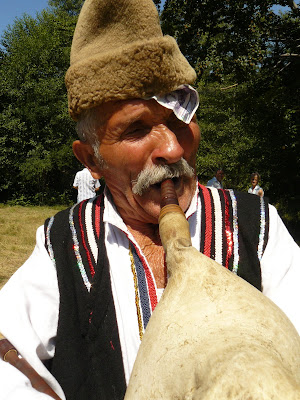
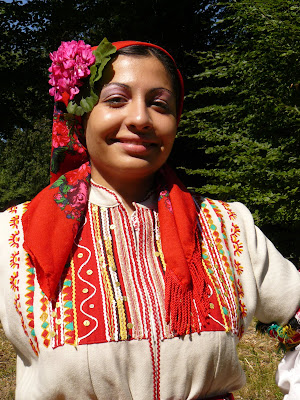
The Bulgarian folklore festival in Predel just ended today, I thought I would post some of the photos. The location is absolutely beautiful and the name of the festival is fitting because the mountains really do sing with folk music.
It was a great experience and I'll posts about the weekend following this week.
Historically the homeland of Alexander the Great, Macedon was a ancient kingdom that became a geographic region over time. When the Ottoman Empire fell, the the preceding power vacuum caused the political national groups of Serbia, Bulgaria and Greece to fight over the spoils. The Balkan Wars thus ensued and everyone ended up hating each other.
Macedonia, the word, is a time bomb waiting to happen. And that has happened, more than once. Over the past 100 years, four countries have been simultanenously claiming their Macedonian heritage and the Macedonian name much in the the way that Italians would claim their Roman heritage. The heritage is there . . . but there isn't exactly a clear definition of who is from the ancient Macedonian kingdom. Like most things in the Balkans, you get many nation states claiming a common heritage and making it an issue of national pride who is really (for instance) "Macedonian".
When the dust settled, Serbia had gained the lion's share of the region by making it a republic in its ill-conceived federation of states. Bulgaria lost a large portion of the ethnically Bulgarian regions and was left with the Pirin Mountains. Greece claimed the large southern part with the largest city Thessaloníki--the very same city that birthed the founder of the modern Turkish state-Mustafa Kemal Atatürk. Again we have the wonderful soft contradictions permeating the Balkan culture.
What the heck does FYROM Mean?
About 15 years ago, some of you might have noticed that a new country popped up in the Balkans called FYROM and you probably paused for a second to remark on its awkwardness. I bet even some of you tried to pronounce it (hand raised) -- f i r o m ? It actually stands for Former Yugoslavia Republic of Macedonian, which was the official name of the country when it was recognized in 1993 by the United Nations. Why would any budding nation choose to A) Pick an incredibly awkward acronym that stupid Americans would think is the actual name of the country, B) mention the country the declared independence from in their nation's name (Former English Colony United States of America, FECUSOA)? Answer: Well, someone had already taken that name . . . actually two countries, both Bulgaria and Greece.
The largest geographical region in Greece is called Macedonia and I'm sure you could imagine the confusion and outrage of the Greeks that their newly formed neighbor to the north was called the same name as their own territorial claim to Macedonian linage. This outrage caused Macedonia (now we are talking about the political state) to be initially called FYROM within the international community.
Greek Macedonia
Bulgaria also lays claim to name Macedonia to describe its southwest region encompassing the Pirin Mountains. This is seen more as a description of a cultural and territorial region than as a politically recognized region.
Pirin Macedonia
So, one has to create a fine but important line between the political Macedonia and the cultural Macedonia. There are parts of traditional Macedonian culture sprinkled throughout the northern part of Greece, southwest Bulgaria, Serbia, Kosovo and Macedonia.
Bulgarian or Macedonian Folk Songs?
When a Bulgarian from the southwestern Bulgaria (Macedonian region) celebrates a national holiday, birthday or festival, he (usually not she . . .) starts drinking rakia--grape brandy that is akin to moonshine--and sings the traditional folk songs that were taught to him as young child. But in this region of Bulgaria, what are those folk songs . . . ? They're old Macedonian songs from before Macedonia and Bulgaria where divided from the Balkan Wars.
When browsing the online chatter, Macedonians are indignant that Bulgarians sing Macedonian folk songs. Those songs represent a nationalism that is being attacked by other countries claiming those songs as part of their cultural ethos. Bulgarians are, for the most part, dismissive of Macedonia and its claims of difference--almost as if they were a the prodigal son that joined Serbia and will one day return. The conversation almost always ends with "Oh, they are Bulgarians; they speak Bulgarian with an accent".
So which are they, Bulgarian folks songs or Macedonian folk songs? Neither. They are folk songs sung from the geographic region of Macedonia in both Macedonia and Bulgaria. (How about that for running a fine line . . . )
This weekend, I will be attending the Pirin Sings (Пирин Пее) in the Pirin Mountains and I hope to gather a better picture of the traditional folk music played there. Pirin Sings (Pirin Pee or Пирин Пее) is a folklore festival held every two years on the first weekend of August where thousands gather in the mountain meadows for singing, dancing, drinking and eating. What's not like? Its a recommended hidden jewel of Bulgaria for intentional tourists.
I'll post examples of Macedonian music after the weekend, but for now, here's a famous Bulgarian Macedonian Folk Song that is sung in both Macedonia and Bulgaria.
Tangentially Referenced:
For anyone that has access to JSTOR, this is a great article about the Politics of Folk Music in the Balkans: The Politics of Folklore in Bulgaria, Carol Silverman




 Posts
Posts

